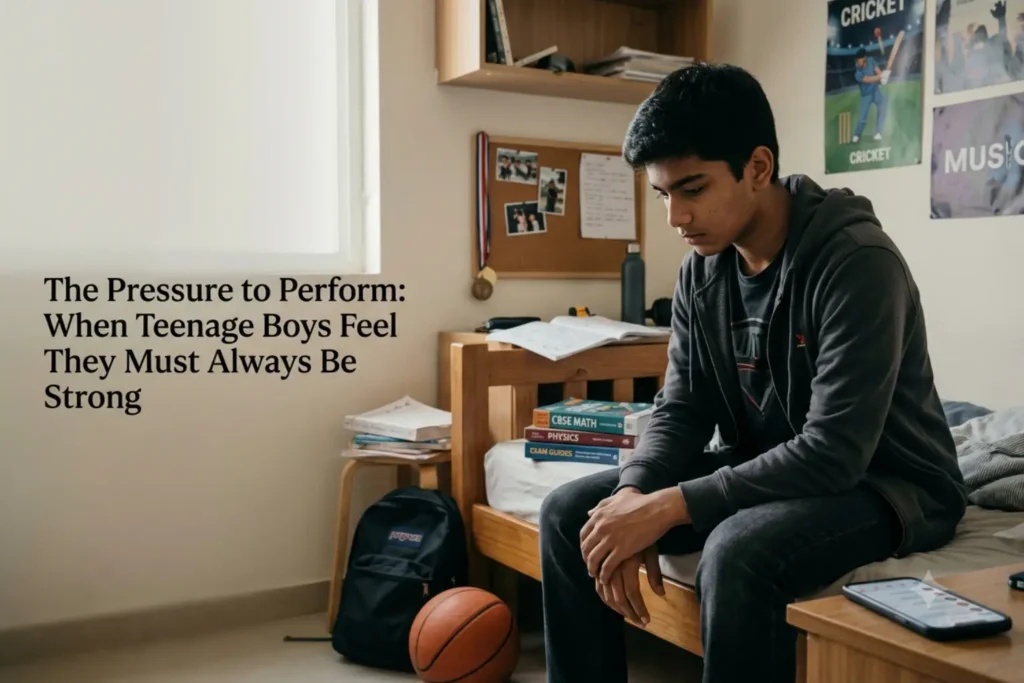
The Pressure to Perform: When Teenage Boys Feel They Must Always Be Strong

We often talk about the social media pressures facing teenage girls, but a quieter, equally heavy storm brews silently in the lives of teenage boys.
From early childhood, young boys absorb subtle cultural messages: Be tough. Don’t show vulnerability. Win at all costs. Figure it out on your own.
By the time they enter high school, these messages solidify into an unforgiving script. They face relentless academic competition, expectations to excel in sports, social media standards of physical fitness, and an implicit rule never to admit fear, sadness, or confusion.
When society equates masculinity with unbreakable strength, emotional expression goes underground. Instead of seeking support when overwhelmed, teenage boys often retreat into isolation, anger, or intense internal performance anxiety.
The Anatomy of Silent Endurance
Teenage boys process distress differently when they feel conditioned to hide emotional vulnerability. Because direct sadness is discouraged, psychological stress often manifests in indirect ways:
- Irritability and Outbursts: Fear, insecurity, or anxiety frequently present as sudden anger, irritation, or emotional withdrawal.
- Over-Fixation on Achievement: Some boys dive obsessively into academics, fitness routines, or online gaming to maintain a sense of control and external validation.
- The Isolation Trap: Feeling unable to share genuine fears with friends or family, they retreat behind closed doors, carrying high stress levels entirely alone.
A Real-Life Example: The "Unstoppable" Athlete
Consider Arjun, a 16-year-old high school student. He was his school’s basketball captain, maintained top academic grades, and was widely regarded by teachers and parents as balanced, resilient, and confident.
However, behind his polished exterior, Arjun was struggling with severe anxiety. Between preparing for competitive entrance exams and leading his sports team, he slept less than four hours a night. When he missed a crucial game-winning shot during a tournament, his world unraveled. Instead of talking to his parents, Arjun withdrew completely. He stopped eating dinner with the family, spent hours staring at his bedroom ceiling, and snapped over minor household questions.
His father, noticing the sudden shift, avoided lecturing or offering quick solutions. Instead, he invited Arjun for a late-night drive to grab a cold drink. Sitting side-by-side in the car, his father shared a candid memory of his own failures and fears when he was 16.
For the first time in years, Arjun broke down and admitted: “Dad, I’m terrified of letting everyone down. I feel like if I’m not perfect, I’m nothing.”
His father’s gentle response changed everything: “Your job isn’t to be invincible, Arjun. Your job is just to grow. You don’t have to carry the entire world on your shoulders.”
That single conversation transformed their relationship. Arjun began working with a school counsellor to set healthier academic and athletic boundaries, realizing that asking for help was a sign of maturity, not weakness.
3 Ways to Help Teenage Boys Release the Pressure
- Model Emotional Honesty: Fathers and male role models need to share their own mistakes, fears, and stress management strategies openly. Showing that strong adults experience self-doubt normalizes those feelings for young men.
- Reframe Vulnerability as Courage: Teach teenage boys that admitting when they are overwhelmed requires far more strength than hiding behind a tough facade.
- Listen Without Offering Instant Fixes: When a teenage boy opens up, resist the urge to immediately solve his problem or lecture him. Simply validate his experience: “That sounds really heavy, and I’m glad you told me.”
Conclusion
True strength isn’t about suppressing emotion or pretending that nothing hurts; it is the courage to be honest about your limits and seek support when life feels overwhelming.
As parents, mentors, and educators, our duty is to rewrite the script for the next generation of young men. When we give our sons permission to put down the heavy mask of perfection, we don’t just reduce their anxiety we raise emotionally healthy, resilient men capable of building genuine human connections.
Share Article
Recent Posts
-
 Jowar Prices Touch Record Rs 100 per Kg in Karnataka, Hotels and Consumers Feel the Heat
-
 Describing the Words
-
 Intimacy After 40: The Conversations Couples Avoid
-
 The Pressure to Perform: When Teenage Boys Feel They Must Always Be Strong
-
 The Unpaid CEO of the Home: Why Women Manage More Than Household Chores