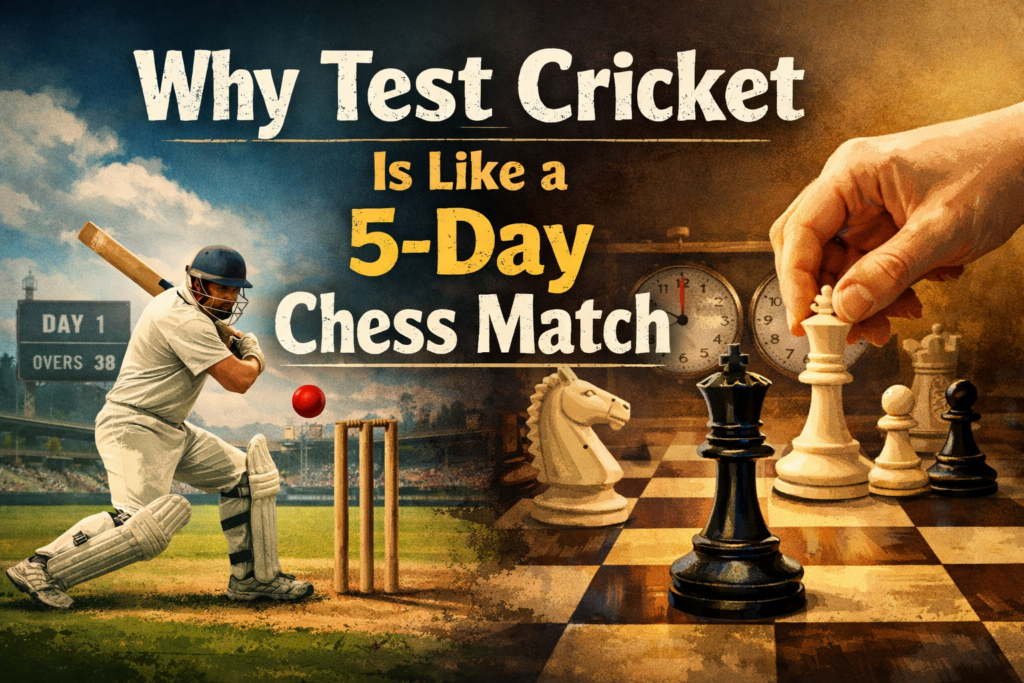
Why Test Cricket Is Like a 5-Day Chess Match
In today’s world speed is very essential so we have T20 cricket and Blitz Chess, in which both the games are played very fast and it gets over very quickly and in other hand there exists a format in both chess and cricket where you need patience, calculations and endurance. Test match in cricket and Classical chess where it is a battle which stretches your mind.
Here’s why Test cricket is essentially a five-day chess match played on grass.
1. Opening Theory: The First Session Is the Opening Phase
In chess, opening is very important it determines the structure, long term plans and strategy. Top Grandmasters just don’t play moves -they build positions.
In Test cricket, the first session is the equivalent of the opening phase.
- Fast bowlers need to ball with discipline line and length.
- Batters leave the deliveries.
- Conditions are assessed thoroughly.
- Early mistakes can take a game away from you.
Just as losing a piece early in chess is catastrophic, losing 2 to 3 wickets in the first hour can ruin a Test match.
2. Middle Game: Pressure, Traps & Tactical Battles
The middle game is very important in chess where the pressure builds. Sacrifices are to be made, Traps come into play, there will be squeeze in positions. It is literally a psychological war. One silly mistake or blunder might take away a game from you.
In Test cricket, this phase often spans Days 2–4.
Think of:
- Long spells by bowlers setting up batters
- Close-in fielders creating mental pressure
- Patience turning into frustration
If we consider batting, player Rahul Dravid used to bat for hours, it was pure positional chess — he will be improving his position slowly without takin g risks and by this he will strategies to play longer.
On the bowling side, someone like James Anderson doesn’t just bowl deliveries. He sets traps for multiple overs, where he waits for batter to commit mistake, he balls outswing ball after ball, overs after overs, then suddenly he balls inswing which traps batter and gets out. multiple overs. That’s a tactical combination worthy of a grandmaster.
3. Endgame: Survival or Checkmate
In chess, the endgame is very challenging and tricky, if one move is blundered then the game is over.
Day 5 of a Test match is the same as the end game in chess.
- Cracked pitch.
- Tired bowlers.
- Fielders crowding the bat.
- Every decision amplified.
A team defending 180 on Day 5 is like a player defending a worse endgame — precision matters more than flair.
In 2019 at Headingley Ben Stokes England batter pulled a miracle; by winning the lost game, it feels like a lost position in chess turned into checkmate.
- Extensive Practice approximately 10000 to 20000 hours.
- They study thousands of positions which which helps in developing memory.
- Under time pressure they develop psychological toughness.
To put it another way, mastery in chess becomes quite specialised. The benefits of having more IQ fade once players reach a particular level of intellect.
4. Moves Control: Not Every Move Is Aggressive
In blitz chess, you attack quickly, you will be not having ample time to think, but in classical game, you move by planning.
Similarly:
- T20 is equivalent to blitz chess
- ODI is equivalent to rapid chess
- Test is equivalent to classical chess
Captains must decide when should attack and when to go defence. Timing is very important choosing the right movement is important. Similarly in Chess, we should wait for the opportunity to attack king.
It’s all about timing — like choosing the correct moment to launch a kingside attack.
5. Mental Endurance Wins Championships
A classical chess game lasts at least 5 to 6 hours. Test match lasts up to 30 hours across 5 days.
Both demand:
- Emotional control
- Patience
- Energy management
- Long-term strategic thinking
Even legends like Garry Kasparov emphasized stamina as much as brilliance. The same is true for Test greats.
6. The Beauty of the Draw
In faster formats, fans want clear winners.
But in both classical chess and Test cricket, a draw can be heroic.
Saving a Test match after 150 overs of defence is like holding a theoretically lost rook endgame. It’s art. It’s resilience. It’s mental strength at its highest level.
Conclusion: Why This Matters
In a fat content era, you will get reward in Test Cricket and Classical Chess once you are indulged in depth analysis.
They teach:
- Delayed gratification
- Strategic thinking
- Patience under pressure
- Psychological endurance
And that’s why Test cricket isn’t slow — it’s sophisticated.