What Happens to EV Batteries After They Die?
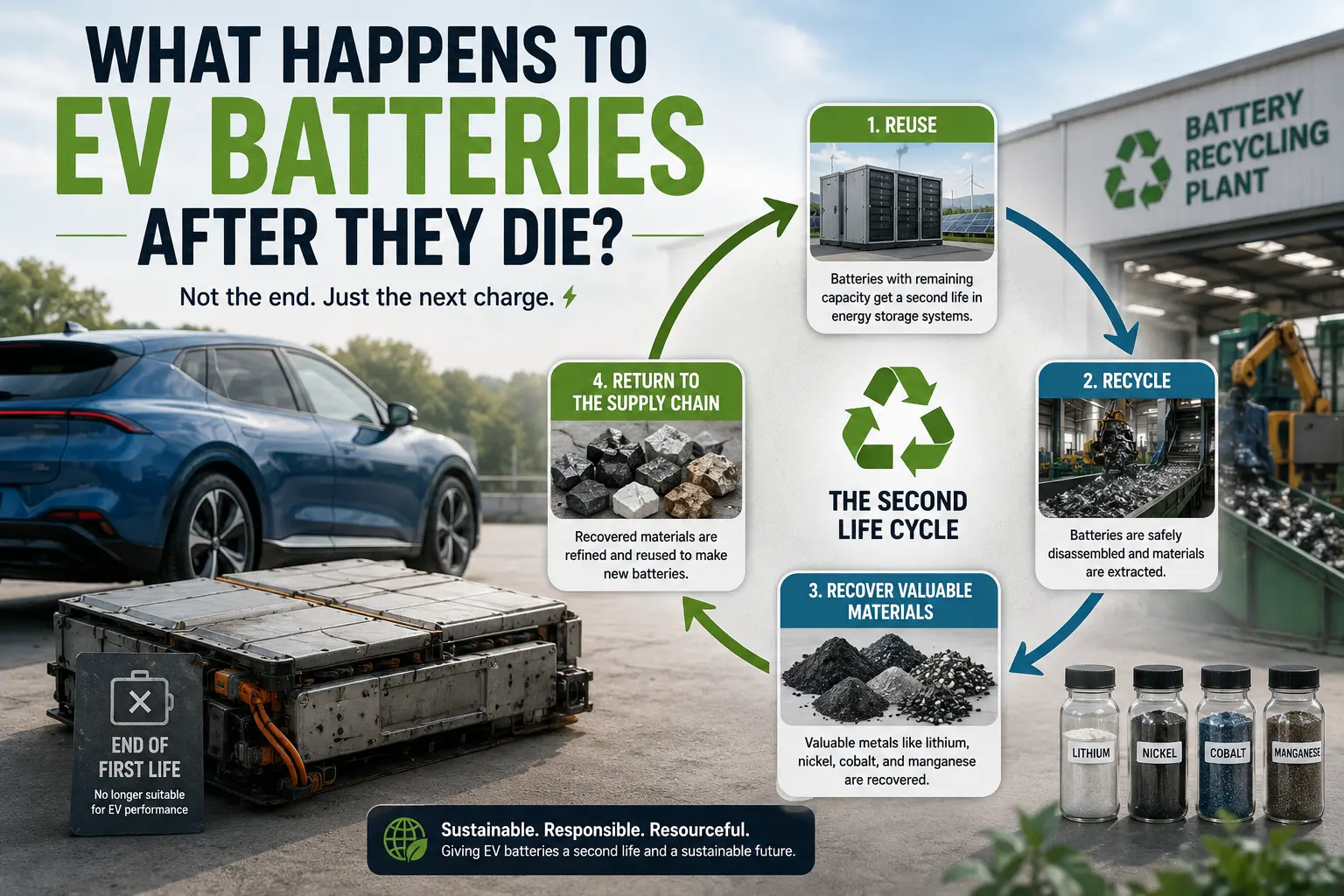
1. Reuse of Battery
Energy Storage: Old EV battery packs are bundled together to act as massive power banks for:
- Home battery storage
- Backup power systems
- Grid-scale energy storage
Companies and utilities are increasingly exploring these applications.
Renewable Integration: They are frequently used to store excess energy generated by solar and wind farms, easing grid strain.
2. Recycling and Material Recovery
Once company confirms that they cannot use a battery, they go for recycling process where in they recover the materials which are there like
- Lithium
- Nickel
- Cobalt
- Copper
- Aluminium
(e.g., Redwood Materials or Li-Cycle)
Most of the major companies and battery manufacturers unit are investing for the recycling of the battery, which helps in reducing mining and recovers above said materials.
Discharging & Shredding: The batteries are discharged completely and they are submerged in fluid and made it into a pitch-black powder known as “black mass”.
Material Extraction: Using metallurgy (using chemical solvents) or pyrometallurgy (high- temperature melting), facilities filter and extract up to 95% of the expensive metals, which are mentioned above.
3. Rebirth
4. The Battery Degrades
Lithium -ion batteries lose their ability due to Charging and Discharging cycles, time of the battery, temperature exposure and charging frequency.
A battery that originally provided 400 km of range might provide only 320 km after many years.
5. The Battery can be Refurbished
6. How long do EV batteries last?
Most modern EV batteries are designed to last:
- In normal usage 8 to 15 years and 1,50,000 km to 3,00,000 km.
Many EVs on the road today still retain more than 80% of their original capacity after a decade of use.